
Back in 2020 I had the idea that I would make a whole series of illustrated infographics where I would feature different animal fun facts. Despite my big goals, it began and ended with just one infographic on spiders. Maybe one day I’ll pick this series back up, but no promises!
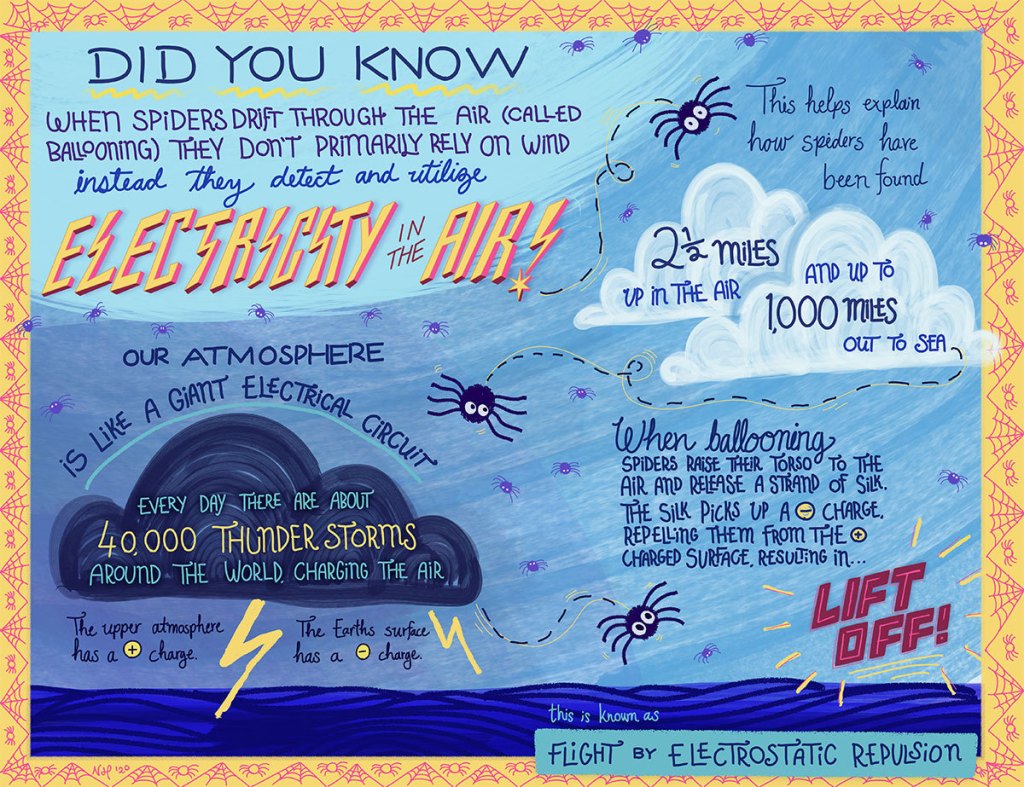
The image reads:
🕷
Did you know when spiders drift through the air (called ballooning) they don’t primarily rely on wind, instead they detect and utilize electricity in the air!
🕷
This helps explain how spiders have been found 2.5 miles up in the air and up to 1,000 miles out to sea.
🕷
Our atmosphere is like a giant electrical circuit. Everyday there are about 40,000 thunderstorms around the world, charging the air. The upper atmosphere has a positive charge. The Earth’s surface has a negative charge.
🕷
When ballooning spiders raise their torso to the air and release a strand of silk. The silk picks up a negative charge, repelling them from the positively charged surface, resulting in lift off!
🕷
This is known as flight by electrostatic repulsion.
🕷
Bonus: even on clear days the air carries a voltage of about 100 volts per every metre off the ground. Stormy conditions can increase this to tens of thousands of volts per metre.
To learn even more (!!!) read the article ‘Spiders Can Fly Hundreds of Miles Using Electricity’ by Ed Yong in the Atlantic
